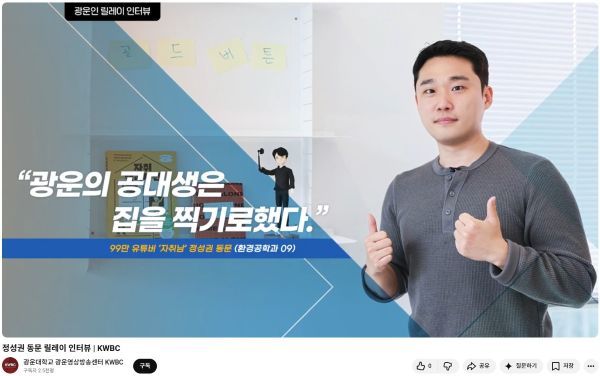
The Kwangwoon Engineering Student Who Decided to Film Houses
Meet Alumnus Sung-kwon Jeong (Dept. of Environmental Engineering, ’09), the Creator Behind the 990K-Subscriber YouTube Channel 'Jachwinam'
In an era where single-person households have topped 10 million in Korea, one content creator has captured the hearts of 990,000 subscribers by capturing the living spaces of those who live alone. Sung-kwon Jeong, an alumnus who graduated from Kwangwoon University with a degree in Environmental Engineering, worked at a mobile app marketing agency before starting his YouTube journey. Today, he successfully runs the highly popular channel 'Jachwinam' (meaning 'A Man Who Lives Alone'). Although his current path is entirely divorced from his college major, his journey has been more authentic and grounded than anyone else's.
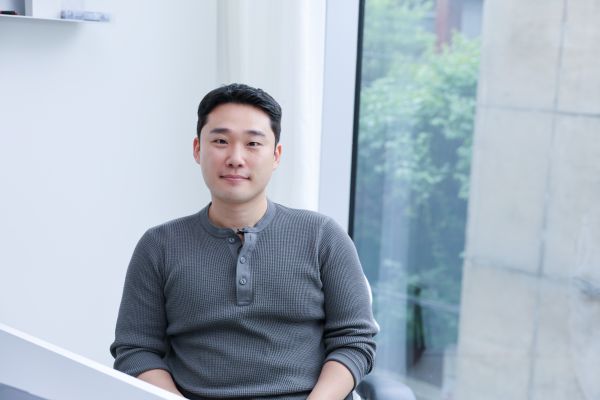
A Path Shaped by 'Coincidence'—From Major to Career
Entering the Department of Environmental Engineering was not the result of a meticulously calculated plan for Jeong. One of his primary criteria for choosing a university was simply "proximity to home." Furthermore, because he had taken the Type B (Humanities/Arts-leaning) Mathematics exam in high school, there weren't many engineering schools that accepted his track. Kwangwoon University’s Environmental Engineering program happened to be one of them.
"I studied because I was told to, and I just chose my university and major based on my test scores," Jeong recalled. "Back then, I didn't really have a clear vision of what I wanted to become."
While he wasn't deeply passionate about his academic major, he enjoyed campus life to the absolute fullest. He was actively involved in a marketing club, played in a student band, and even made it to the finals of the university song festival. He was also selected for the university's Global Challenge Program, which allowed him to put together a team and travel to New York. It was during these experiences that his interest in marketing naturally began to blossom. He eventually declared a minor in Business Administration, diving deep exclusively into marketing courses.
"To complete a double major, I would have had to take accounting principles and logistics, but I only wanted to study marketing. That’s why I settled for a minor," Jeong explained. "Marketing is deeply intertwined with human psychology, which has proven to be incredibly helpful for what I do now."
From Corporate Salaryman to YouTuber
After graduation, Jeong landed a job at a marketing firm specializing in mobile applications. The structured routine and the steady paycheck hitting his bank account every month offered a comfortable level of stability. As he adapted to corporate life, his professional skills grew steadily. Over time, however, questions began to surface. He felt that his compensation did not match the results he was delivering. ‘I’m working this hard, so why is my salary only this much?’
With that thought, he cautiously began to venture into small side businesses. After a few trial-and-error attempts, his third venture was YouTube content creation. In the beginning, he acted as the primary on-camera narrator, sharing practical tips for single living—such as weighing whether a bathtub is truly necessary or comparing instant rice with home-cooked rice.
The ultimate turning point came from a completely unexpected place. A video he casually shot of a friend’s house generated an explosive response. At the time, there was virtually no content showcasing the homes of ordinary people rather than celebrities. His channel became essentially the only platform highlighting the real spaces of single households, and every new upload triggered a massive wave of engagement.
"Back then, my mindset wasn't focused on making a lot of money; I just wanted to do something fun that I was capable of executing," Jeong said calmly. "But things are so different now. I barely get to do the 'fun' stuff anymore, and I'm strictly focused on doing what needs to be done." His gaze, steady and reflective, now carried the undeniable weight of a company CEO.
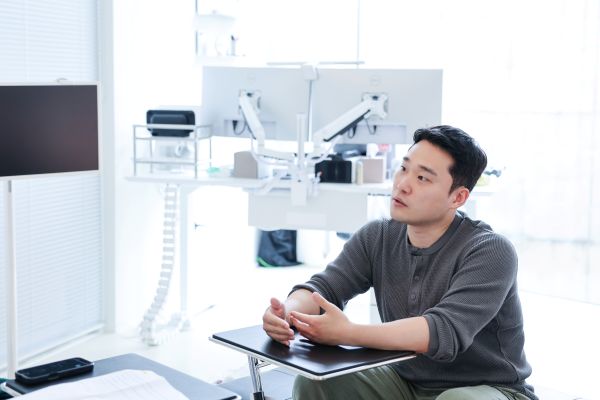
Alumnus Sung-kwon Jeong explaining the strategic direction of the content he produces.
The Secret Behind 990,000 Subscribers
The channel’s mainstream breakthrough can be attributed to two decisive factors. The first was the sheer scarcity of the content. Because videos showcasing the authentic homes of everyday people were so rare, a solid subscriber base began to form naturally.
This spark was fully ignited by the outbreak of COVID-19. Roughly a year after he launched the channel, the pandemic hit. As people spent prolonged periods trapped inside, interest in residential spaces and interior styling skyrocketed. The channel grew at an unprecedented pace. A period that was a disaster for the world turned out to be an unexpected window of growth for Jeong.
As the channel scaled, its target audience naturally broadened. Viewers in their 20s tune in for studio apartment (one-room) layouts, while those in their mid-30s and beyond look for apartment interior inspiration.
The growth did not happen overnight. Rather than an overnight explosion, the channel steadily accumulated 100,000 to 200,000 subscribers each year, eventually bringing the tally to today's 990,000. It has been a long-term marathon—marking nine years of running the channel in total, and five full years under the current format.
'House' vs. 'Home'—It Takes a Person to Make a Home
Having visited hundreds of homes over the past five years, what Jeong discovered wasn't just interior design—it was the people living inside those spaces. The homes of single-person households were physical manifestations of their unique, unadulterated tastes.
From someone who placed a full-sized mahjong table right in the center of their living room to host friends every week, to a resident living in a semi-basement apartment who spent 20 million KRW on top-tier speakers after soundproofing the space—these individuals all shared a common thread: they completely filled their spaces with their own passions without worrying about what anyone else thought.
"When you get married, compromise becomes necessary. Even if you want a racing game simulator seat in the living room, it’s not an easy conversation to bring up," Jeong laughed. "But when you live alone, you can set up a mahjong table, invite four people over every week, and nobody can tell you otherwise. I think that’s one of the defining characteristics of single-person households."
Filming for YouTube also systematically dismantled his own subconscious prejudices. He vividly recalls the shock of interviewing a single man in his 40s. His initial skeptical thought of ‘Why is he living alone in his 40s?’ quickly vanished upon meeting him, turning into self-reflection: ‘I was trapped in a narrow, judgmental stereotype.’
"Every time I shoot a video, my own small view of the world shatters," Jeong shared. "There are over 10 million single-person households in Korea, and it’s not just a story confined to youth in their 20s. We are moving toward a world where individual lifestyles are deeply respected, and I find great meaning in producing content that captures that cultural shift."
Jeong frequently references the distinction between a "house" and a "home." Even if there are tens of thousands of studio apartments with the exact same square footage across the country, the people living inside them are all fundamentally different. A physical structure only becomes a home when a person steps inside—and that simple truth is the exact reason this channel has thrived for five years.
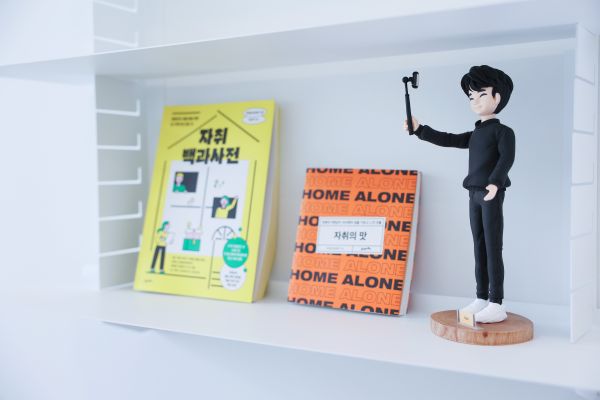
How Technology Re-defines Housing Conditions and Trends
Meeting hundreds of single residents has given Jeong a unique pulse on societal shifts. Just a few years ago, the top priorities when looking for a place to live were "proximity to a mega-mart" or "being right next to a traditional market." Today, those priorities have flipped completely.
"I actually interviewed someone who bought land and built their own house from scratch. When I asked why they chose that specific remote location, they said it was 'the absolute borderline where Coupang rocket delivery could still reach,'" Jeong noted. "With early-morning delivery and quick-commerce becoming embedded in daily life, physical proximity to a grocery store has dropped significantly in priority. Technological advancement is fundamentally reshaping residential trends."
Jeong also offers an insightful perspective on why Hanriver-view apartments became the ultimate real estate megatrend. In the past, residential areas near the Han River faced constant complaints due to the noise and exhaust fumes coming from the adjacent expressways. Today, however, window and ventilation technologies have advanced to the point where a single window can entirely seal out external noise. Being able to enjoy the view without any of the traditional inconveniences is what ultimately flipped the market trend.
Dreaming of Content with Timeless Longevity
When asked where he sees himself in five years, Jeong bypassed grand corporate goals, offering a modest yet grounded aspiration instead.
"I don't have a grandiose ambition to change the world or deliver a profound social message," Jeong stated. "I simply want to keep doing what I’m doing right now, work hard alongside my team, and hope that our viewers continue to find our content genuinely engaging."
What he desires is simple: to create content that quietly maintains its place over decades, much like classic, long-running Korean TV programs like 6 O'Clock My Hometown or Korea Singing Contest. Just as people always need to eat regardless of changing trends, the topic of "home" will always remain relevant to everyone. That is precisely why he intentionally focuses on ordinary, everyday homes around us rather than bizarre or ultra-luxurious mansions. To be like a bowl of plain white rice—something that never grows tiring and stays by your side for a long time—is more than enough for him.
Lastly, he candidly pulled back the curtain on the glamorous exterior of being a full-time creator. He noted that if a job looks easy from the outside, it is simply proof that the person has already poured countless hours of grueling labor into perfecting it. Behind a single polished video lies a mountain of invisible work, from planning and filming to endless rounds of editing.
"I have been working 70 hours a week for six years straight," Jeong shared as a final word of advice. "I highly encourage my university juniors to gauge the true weight of that commitment first—and if you still feel the burning passion to do it, then by all means, dive headfirst into the world of YouTube."
★ Click the image above to watch the full interview video with alumnus Sung-kwon Jeong on YouTube.