Professor Song Ik-hwan’s Research Team Wins Grand Prize at the 2026 Korea Electromagnetics Engineering Society Summer Conference
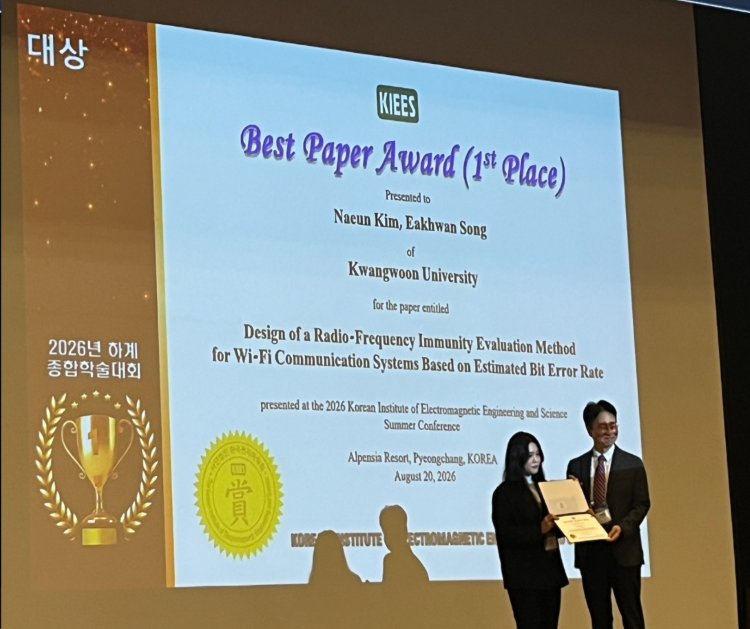
Professor Song Ik-hwan and Kim Na-eun, a combined M.S./Ph.D. student, received the Grand Prize.
Professor Song Ik-hwan and Kim Na-eun, a combined M.S./Ph.D. student from the Department of Electronics and Communications Engineering at Kwangwoon University, have received the Grand Prize (Best Paper Award, 1st Place) at the 2026 Korea Electromagnetics Engineering Society (KIEES) Summer Conference, recognizing the research team’s outstanding achievements in the field of electromagnetic compatibility (EMC).
At the conference, held in Pyeongchang from August 19 to 21, Professor Song’s Electromagnetic Wave Systems Laboratory received the Grand Prize for its paper titled “Design of a Radio-Frequency Immunity Evaluation Method for Wi-Fi Communication Systems Based on Estimated Bit Error Rate.” Kim Na-eun served as the first author, while Professor Song Ik-hwan served as the corresponding author.
In the study, the research team proposed Frame-Based Estimated Bit Error Rate (FB-BER) as a new performance metric that indirectly estimates the physical-layer bit error rate by utilizing frame information from the data link layer. Based on this approach, the team analyzed degradation in communication performance according to noise amplitude and frequency and developed a Noise Susceptibility Index (NSI) to quantify immunity. Through experiments, the researchers demonstrated that the RF immunity of wireless communication systems can be precisely evaluated at the physical layer.
The achievement is particularly significant as it represents an important advance in technology for quantitatively evaluating the immunity of semiconductor and automotive electronic systems against malfunctions and performance degradation caused by electromagnetic noise. Professor Song Ik-hwan said, “Our research on quantitatively evaluating the immunity of semiconductor and automotive electronic systems against malfunctions and performance degradation caused by electromagnetic noise has led to a meaningful achievement. We will continue our research and mentoring efforts to cultivate researchers with expertise in electromagnetic compatibility as wireless communication systems become increasingly faster and more sophisticated.”




