HUSS Global Coexistence Consortium Sweeps Awards, Including the Minister of Education Award, at the HUSS Convergence Camp Insight
The HUSS Global Coexistence Consortium, led by Kwangwoon University, achieved outstanding success at the 2026 HUSS Convergence Camp Insight, held at Sono Calm Gyeongju Resort from July 1 to 3, 2026, winning the Minister of Education Award along with several other prestigious honors.
Hosted and organized by the Ministry of Education, the National Research Foundation of Korea (NRF), Gyeongsangbuk-do Province, and the Council for the Humanities and Social Sciences (HUSS) Initiative, the 2026 HUSS Convergence Camp brought together students from HUSS programs across the country. The camp aimed to foster creative solutions to the complex challenges facing future society while expanding interdisciplinary thinking through collaboration and exchange among universities. Participants engaged in a variety of activities, including a hackathon, an AI competition, and other collaborative programs, sharing their academic backgrounds and experiences while developing the competencies required of future convergence leaders.
In the hackathon, which featured 55 teams from across the country, two teams from the HUSS Global Coexistence Consortium that included Kwangwoon University students advanced to the final round. The teams, "Onsaemiro" and "Noinfree-!", ultimately received the Grand Prize (First Prize) and the Excellence Award, respectively, demonstrating the consortium's outstanding performance and innovative problem-solving capabilities.
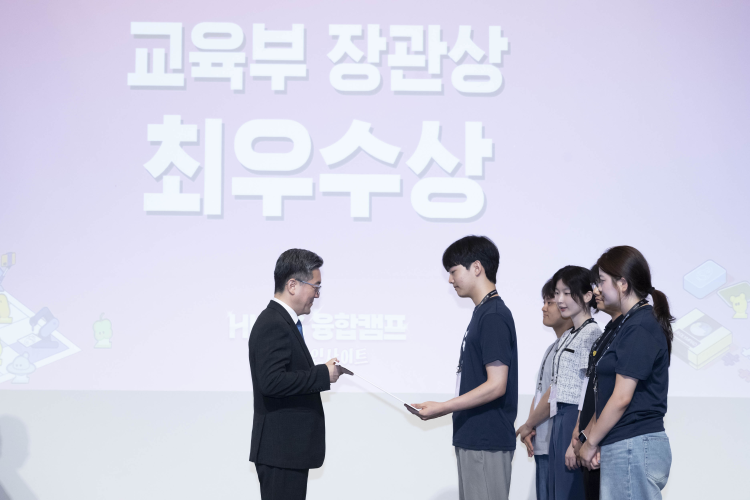
Won the Grand Prize at the 2026 HUSS Convergence Camp (Insight) Hackathon.
The Grand Prize, accompanied by the Minister of Education Award, was awarded to Team Onsaemiro, led by Gyowon Lee, a student in the School of Information Convergence at Kwangwoon University. Team Onsaemiro proposed a pre-publication verification infrastructure that reviews traditional cultural content for potential cultural distortions before its release and publicly documents and shares the basis for each review. The judges highly commended the proposal for establishing a reliable verification framework that supports the accurate preservation and responsible utilization of traditional culture, earning the team the competition's highest honor.
Meanwhile, Team Noinfree-!, which included Sinhye Bang, a student in the Department of Public Administration at Kwangwoon University, received the Excellence Award (President of the National Research Foundation of Korea Award) for its proposal, "Simplifying Kiosk Operation through NFC Tagging." The team presented a user-centered solution that leverages Near Field Communication (NFC) technology to help older adults who are less familiar with digital technologies use self-service kiosks more easily and conveniently. The innovative approach was highly praised for improving digital accessibility and enhancing convenience for senior users.
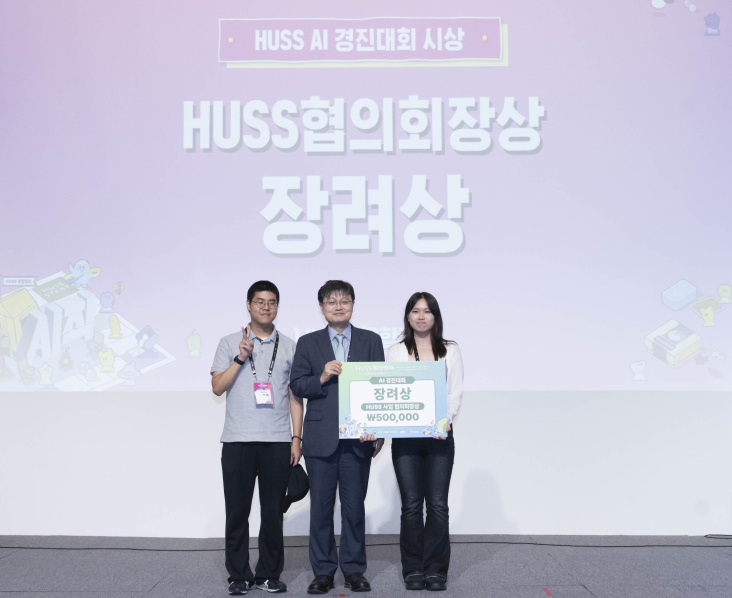
Won the Encouragement Award at the 2026 HUSS Convergence Camp (Insight) AI Competition
In addition, in the AI Competition, which featured 20 teams from across the country, Team "Jeongyung Goneung," consisting of Jiwoo Lee and Wonjun Jang (School of Information Convergence, Kwangwoon University), received the Encouragement Award (Chair of the HUSS Council Award). The team proposed an AI-powered gamified Korean pronunciation correction application for children with articulation and phonological disorders, which analyzes phonological processes to provide personalized pronunciation feedback. The application enables school-aged children to practice pronunciation and receive feedback conveniently at home. The judges recognized the project for its originality, noting that it addressed a genuine societal need with an innovative solution that had not previously been explored.
The 2026 HUSS Convergence Camp provided students with a valuable opportunity to transform creative ideas into practical solutions for real-world social challenges while broadening their interdisciplinary perspectives through collaboration with students from other universities. The camp was particularly meaningful in showcasing students' ability to work across institutional boundaries to address social issues and develop AI-driven, public needs-based solutions, demonstrating the core competencies of humanities and social sciences convergence education.
Meanwhile, the HUSS Global Coexistence Consortium has been supported by the Ministry of Education and the National Research Foundation of Korea (NRF) from 2024 to 2026 as part of the Humanities and Social Sciences (HUSS) Initiative, with the goal of fostering interdisciplinary talent in the humanities and social sciences. The consortium will continue to support the development of future leaders through a wide range of collaborative programs designed to cultivate convergence competencies that meet the demands of an evolving society.