"The Era of Missiles and Drones: Exploring the Future Paradigm of Security"
2026 Missile Defense and Space Security Strategy Seminar Held Industry, Academia and Research Experts Gather to Discuss Future Security Strategies
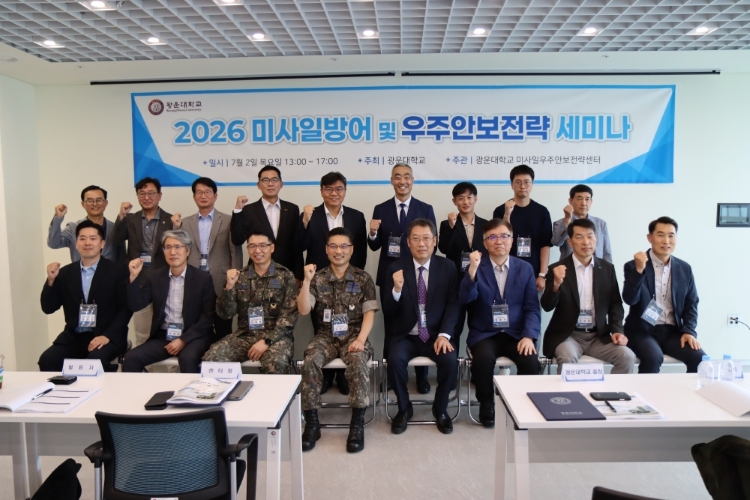
Group Photo of Participants at the 2026 Missile Defense and Space Security Strategy Seminar
Kwangwoon University's Missile and Space Security Strategy Center successfully hosted the 2026 Missile Defense and Space Security Strategy Seminar on July 2 at the University's Pangyo Campus, bringing together leading experts from the national security and defense industry sectors. The seminar was organized to explore the future direction of the Korean Peninsula's air defense system amid an increasingly complex security environment characterized by the growing threats posed by missiles and drones. It also aimed to strengthen collaboration among industry, academia, and research institutions in the fields of missile defense and space security. More than 50 experts attended the event to discuss key security challenges while sharing the latest research findings and technological developments.
Hosted by Kwangwoon University's Missile and Space Security Strategy Center, the seminar was attended by representatives from Kwangwoon University, the Agency for Defense Development (ADD), LIG D&A, Hanwha Systems, Funjin, and the Advanced Institute of Convergence Technology (AICT). Participants examined the evolving nature of modern warfare, where missiles, drones, and artificial intelligence-based surveillance and command-and-control technologies are playing increasingly critical roles. Discussions focused on developing integrated air defense and space-based surveillance systems tailored to the security environment of the Korean Peninsula.
A major highlight of the seminar was the emphasis on redefining the concept of "Air Denial" in light of lessons learned from the Russia–Ukraine War and the Iran conflict. Participants noted that achieving air superiority alone is no longer sufficient to accomplish military objectives. Instead, future operational concepts must integrate ground-based air defense networks, counter-drone capabilities, and defenses against long-range precision strike threats. There was broad consensus that the Air Denial concept should be further developed as a core strategic framework for future warfare. The seminar also featured presentations and discussions on several emerging topics, including photonics-based radar technologies, short-range air defense interception systems, AI-enabled air defense operations, and the current state of counter-drone systems. In addition, participants underscored the importance of developing ballistic missile early warning satellites capable of significantly enhancing the detection of North Korean ballistic missile launches.
Kwangwoon University President Yoon Do-young remarked, "This seminar provided a valuable opportunity for experts from academia, research institutions, and industry to come together and explore missile defense and space security strategies optimized for the Korean Peninsula in an era of rapidly evolving security challenges. Kwangwoon University will continue to lead advances in future security technologies through sustained research and academic collaboration while contributing to national security policy and technological innovation." Jung Yong-sik, Director of the Missile and Space Security Strategy Center, emphasized, "As missile and drone threats continue to grow simultaneously, air defense can no longer be approached solely from the perspective of individual weapons systems. Detection, tracking, command and control, interception, and space-based surveillance must all be considered within a single integrated framework."
The seminar is expected to serve as an important catalyst for strengthening research capabilities in missile defense and space security while expanding collaborative networks among universities, research institutes, government agencies, and defense industry partners.




