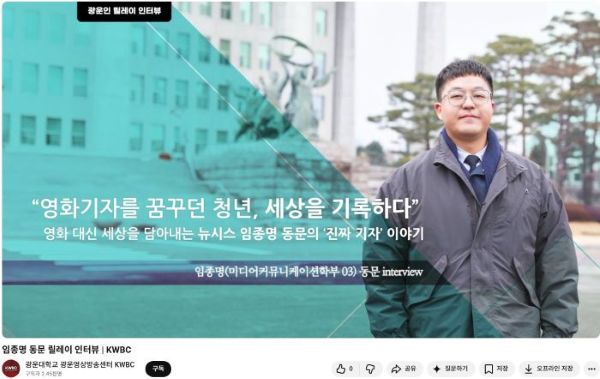
"From Aspiring Film Journalist to Chronicler of the World" > The ‘Real Journalist’
- The story of Lim Jong-myung, a Newis alumnus who captures the world instead of films — a “real reporter”
(School of Media and Communication, Class of 2003) -
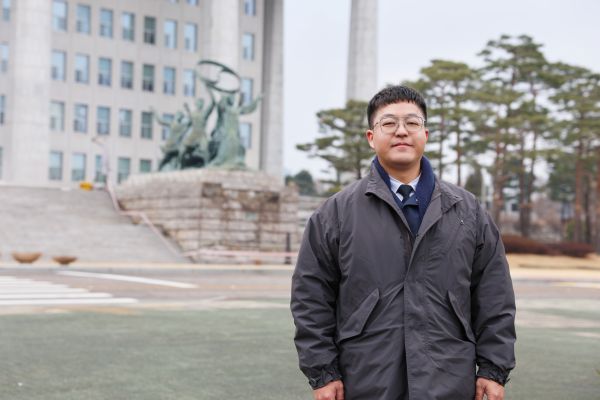
Posing in front of the National Assembly, one of the places he now covers
Some people think journalism is a romantic profession: chasing stories in the field, looking into the hidden side of society, and revealing truths the public does not know. Others shake their heads. Online abuse, pressure to break news first, low pay… many wonder who would even want to become a reporter these days.
So what does the life of a journalist mean to Lim Jong-myung, an alumnus who has spent 17 years at Newsis, one of Korea’s leading private news agencies? In his younger days, he dreamed of becoming a film journalist. By chance, he entered a news agency as a copy editor. Life, after all, does not always go according to plan. The young man who loved films and wanted to write about them now sits in the National Assembly press room, covering the heart of Korean politics.
A young cinephile who dreamed of film
Lim became a journalist because of film. He loved watching movies and found joy in writing reviews. He also spent happy days as a volunteer at the Busan International Film Festival. His interest in journalism began because he wanted to become a film reporter.
During college, he wrote film reviews for Jaju Eonron, the department’s media criticism society, and joined workshops at film festivals, nurturing that dream. In his senior year, he began preparing to apply to film magazines such as Cine21, Movie Week, and Film 2.0. But no hiring notices appeared. While waiting, he turned his attention to a feature editor position at a fashion magazine. He even made it to the English interview, but failed at the very end when he could not finish his final answer.
“That was when I realized most clearly that if you want to seize an opportunity when it comes, you have to be ready for it yourself. It sounds obvious, but when you’re a job seeker, it hits you much harder.”
Three years as a copy editor laid his foundation
That was when he changed course and applied to Newsis. He had already joined the company before his graduation ceremony in February 2010. He says he was lucky, but it was also an opportunity that came to someone prepared.
His three years in the agency’s editorial department were anything but ordinary. His job was to place the flood of incoming stories into the right sections and write headlines that would catch readers’ attention. He also had to endure the intense, demanding guidance of his senior editor.
“At the time, it was really hard. But looking back, I think that senior shaped the attitude I now have as a journalist.”
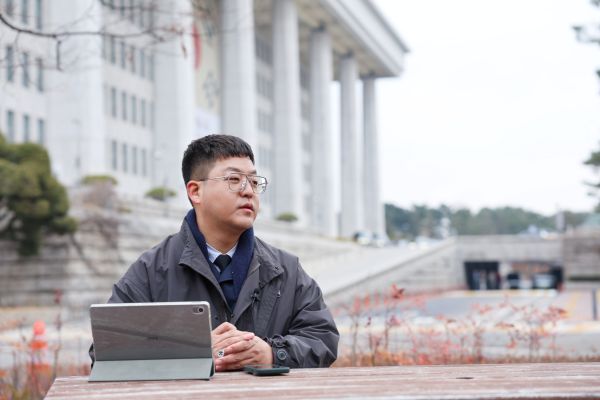
Alumnus Lim Jong-myung reflecting on his 17 years in journalism
He values journalism for its endless learning
Over the next 17 years, the beats he covered became too many to count: Seoul City Hall, police stations, government ministries, international affairs, culture, and now the National Assembly. Each move opened up a new world.
“Whenever you move to a new beat, you naturally have to study the issues and policies in that field. Then at some point, you start to feel like you’ve become a person of broad knowledge.” (laughs)
It is a profession in which you cannot stop studying, even if you want to. At first, that felt burdensome, but he now considers it one of the greatest attractions of the job: a life of continuously learning about the world, not from behind a desk, but out in the field.
“One of the great strengths of this job is that you have to keep learning, and you can fill yourself by seeing, hearing, and feeling up close how the world works.”
Growth Through Perseverance
Of course, journalism is not all romance. He says so honestly. There were definitely moments when he wanted to quit: the pressure of the breaking-news race, crushing deadlines, constantly changing beats, and the malicious comments that sometimes poured in.
One day, when an article he wrote from Paengmok Port while covering the Sewol ferry disaster was featured on a portal site’s main page, it also drew a flood of hateful comments.
While sketching the scene of the Sewol tragedy, Lim noticed a single new shoe sitting alone on the dock. When he walked closer, he saw words written on it:
“Maknae, your friends brought you pretty shoes. Mom, your sister, and your brother all miss you. We’re waiting.”
Later that afternoon, as he looked out to sea again, he found the other shoe lodged on a rock. There was a letter on that one too. It was a message from a desperate family, pouring their hearts into a pair of shoes.
That article remains with him not because it was an exclusive scoop, but because it conveyed, exactly as it was, the feelings of a family that could not be fully expressed in words. It was a moment when he did the most essential thing a reporter can do.
A well-written article can change society. Listening to the voices of those who have been wronged, and turning one’s attention to people pushed into blind spots — Lim says that is why journalists exist.
And if you keep going, he says, there comes a point when “reporting, meeting people, and writing stories” simply becomes second nature. Even when you do not want to do it, you do it anyway. And before long, you realize you have grown. That is the quiet reward this profession offers.
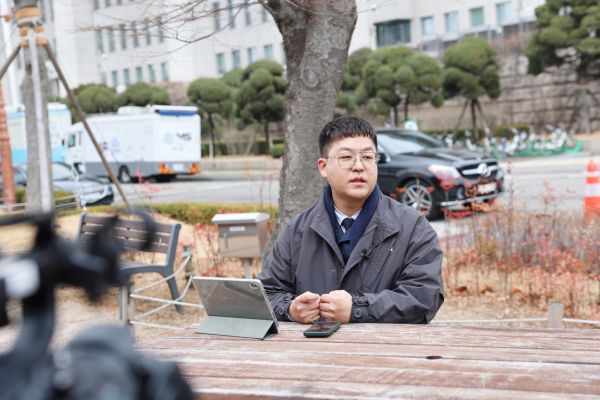
Alumnus Lim Jong-myung offering practical advice to Kwangwoon students aspiring to be journalists
If you like people, this is the right job for you
When asked to sum up the appeal of journalism in one sentence, he paused for a moment and then said:
“If you’re someone who enjoys meeting people and being active, I think there’s hardly a better line of work.”
This is especially true for a wire-service reporter. Covering nearly every major event in the field is part of the job. Watching a presidential impeachment vote from the main chamber of the National Assembly, rushing through the streets at dawn to cover taxi refusals, or holding the hand of a bereaved family member at the site of a tragedy — all of those moments become part of the record, and part of history.
Unlike newspapers or broadcasters, a news agency is a kind of “wholesaler of news,” supplying stories to contracted media outlets. That means reporters must deliver breaking news quickly while also maintaining strict neutrality.
“Unlike a specific newspaper or broadcaster, we have to make sure our reporting doesn’t carry any particular ideological leaning. That’s one of the major characteristics of this work, and something you have to keep paying attention to no matter how many years you’ve been doing it.”
He says that this kind of work is not easy. The more senior you become, the more people and issues you are expected to know. If you do not manage yourself well, what should be strengths can easily turn into weaknesses. Even so, he is still a journalist 17 years later. He has received offers to move elsewhere, but in the end he stayed where he is. Asked why, he smiled shyly and said:
“I think I still want to experience more things as a journalist.”
In the age of AI, the value of journalists is sincerity
This is an era in which ChatGPT writes articles and YouTube algorithms recommend the news. Asked about the value of journalists today, he answered calmly:
“No matter how advanced technology becomes, I think sincerity is what ultimately matters. In this age of information overload, one of the roles of legacy media is to sort out the facts from the flood of information and deliver them to readers.”
These days, he says, when he comes across content on YouTube or Instagram that clearly has the feel of AI, there are moments when he thinks, Is this really right? Can I trust this? He believes that helping resolve exactly that doubt will be the role of journalists going forward.
I simply became a journalist
“What kind of journalist do you want to be?” That was the final question of the interview.
After a long silence, his answer was brief but weighty:
“I want to remain a journalist who contributes, even in a small way, to making our society better.”
It may sound old-fashioned. But the stories he has written over the past 17 years — the new shoes at Paengmok Port, the dawn taxi scene, the voices of residents harmed by the Yongsan redevelopment project — give weight to those words.
Journalism is not a profession that easily makes you rich. Those are his own words. But it is also a profession that allows you to see, hear, and write about how the world works from one of the closest vantage points possible. For someone who feels that is enough, journalism is still a beautiful profession.
★ Watch the interview video with alumnus Lim Jong-myung
(Click the image to go to YouTube.)