“AI Is Now a Partner in Education”
Center for Teaching and Learning Shares Results of the
“2026 Spring Semester AI-Enhanced Teaching Case Competition”
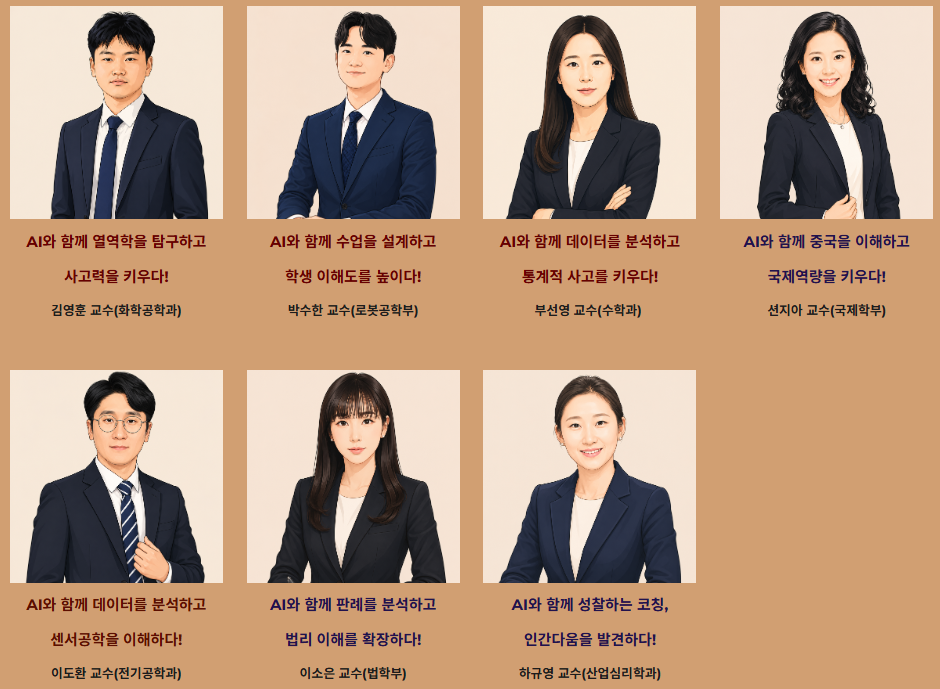
The Center for Teaching and Learning has released teaching cases identified through the “2026 Spring Semester AI-Enhanced Teaching Case Competition.”
The Center conducted the competition through July 13 to identify practical examples of AI use in university courses. It also launched a dedicated webpage to share participating faculty members’ actual classroom applications of AI and their educational outcomes with members of the university community.
The competition was open to faculty members who had completed AI-related e-learning courses offered through the Center for Teaching and Learning’s ONTL (ONline Teaching & Learning) platform. A key feature of the initiative was the creation of a virtuous cycle in which faculty members could apply knowledge acquired through AI training programs directly to their classes and then share the results with others.
The program encouraged instructors to apply AI-based teaching methods learned through e-learning to their own courses and develop them into tangible educational outcomes. By disseminating outstanding practices, the Center also aimed to continuously strengthen faculty members’ AI-based teaching competencies. Participating faculty members shared detailed accounts of their e-learning experiences, classroom implementation processes, and resulting educational effects.
As a result, seven faculty members from a wide range of disciplines, including chemical engineering, robotics, mathematics, international studies, electrical engineering, law, and industrial psychology, shared cases of how they had incorporated AI into their courses and the educational outcomes they achieved.
Reducing the Burden of Preparing Course Materials and Assessments
Professor Kim Young-hoon of the Department of Chemical Engineering, College of Engineering, incorporated a customized chatbot called “MyGPT,” trained on course materials, along with NotebookLM infographics and Gemini-based formative assessment quizzes into his Engineering Thermodynamics course. He also shifted the assessment format toward open-book examinations focused on conceptual understanding.
Professor Park Su-han of the School of Robotics, College of AI Convergence, used AI to generate preliminary quiz questions each week in his Reinforcement Learning course, after which he reviewed the questions himself. This approach increased opportunities for students to engage in repeated learning and review.
Professor Lee So-eun of the School of Law, College of Policy and Law, used AI in her General Theory of Obligations course to create case-study materials based on Supreme Court rulings. She also used AI as a supplementary tool for identifying outstanding student assignments and designing exam questions, allowing her to devote more attention to the core aspects of teaching.
Developing Critical Thinking Through Collaborative Data Analysis
Professor Boo Sun-young of the Department of Mathematics, College of Natural Sciences, introduced an AI-based LMS called Class-analytics into project-based learning activities in her Mathematical Statistics and Practice I course. The system supported team collaboration management and preliminary assessment of reports, after which students were encouraged to revise and improve their work based on the results.
Professor Lee Do-hwan of the Department of Electrical Engineering, College of Electronics and Information Engineering, used AI to reconstruct data from academic papers in his Sensor Engineering course. Students then carried out projects involving regression analysis and transfer-function derivation. AI was also used to help organize English presentation materials, connecting classroom learning with practical experience in real-world data analysis.
Reflecting on Global Competence and Human Qualities
Professor Sean Jia of the Division of International Studies, College of Policy and Law, used Claude as a supplementary tool throughout her Capstone Design Seminar, from designing lecture materials and providing presentation feedback to advising team projects. At the same time, she maintained the principle that all China-related statistics and sources must be personally verified by the instructor. Through this approach, students completed a series of short research papers centered on comparisons between Korea and China.
Professor Ha Gyu-young of the Department of Industrial Psychology, College of Humanities and Social Sciences, took a different approach in her Coaching Practice and Supervision course, using AI not merely as a learning tool but as an object of direct engagement. Students showed AI transcripts of their own coaching sessions and asked it to identify both areas for improvement and their personal strengths. Through this process, all six students were able to articulate, in their own words, the distinctive capabilities of human coaches.
E-Learning Experiences Lead Directly to Classroom Design
Because participation in the competition was limited to faculty members who had completed AI-related teaching-method e-learning courses provided by the Center for Teaching and Learning, participants commonly reported that their e-learning experiences had directly influenced the design of their actual classes.
Professors Kim Young-hoon and Lee So-eun said that the course “Managing University Classes in the AI Era: From Guidelines to Chatbot Teaching Assistants” helped them learn, respectively, how to build customized chatbots and the AI ethics principles of human agency and accountability. These lessons were immediately reflected in the development of the MyGPT chatbot and in procedures requiring instructors to conduct final verification of AI-generated outputs.
Professors Boo Sun-young, Lee Do-hwan, and Ha Gyu-young all completed the course “Smart Lecture Preparation in the AI Era: Maximizing the Use of NotebookLM.” They reported that this experience led them to view NotebookLM not simply as a tool for summarizing and visualizing lecture materials, but as a broader educational resource that could support the restructuring of learning materials and even students’ emotional well-being.
Professor Park Su-han said that the course “Current Trends in Students’ AI-Based Learning Experiences and Strategies for Faculty Use in the Classroom” helped him recognize that the majority of students were already using AI for learning. He incorporated this insight into the design of his quiz-question verification process.
Professor Sean Jia, who completed three e-learning courses including “Effective Writing and Assignment Strategies Using ChatGPT,” said that she learned techniques for structuring prompts and subsequently established the principle of “source-based generation plus instructor verification” throughout her course.
Faculty members who submitted cases to the competition commonly reported that, before completing the e-learning courses, they had regarded AI primarily as a tool for creating materials or assisting with searches. After completing the courses, however, they came to view AI more broadly as an educational partner capable of supporting the full range of course design and assessment activities. The Center for Teaching and Learning has developed the selected outstanding cases into an online webpage and is making them available to faculty members.
Son Hee-sang, Director of the Institute for Educational Innovation, said, “We hope that the outstanding cases introduced through this initiative will serve as practical references for faculty members in designing and operating AI-enhanced courses, help spread educational ideas tailored to the characteristics of different academic disciplines, and contribute to the creation of creative, student-centered classes.”
He added, “Going forward, the Center for Teaching and Learning will continue to identify and accumulate real-world classroom cases at multiple levels—not only cases of AI-enhanced teaching, but also examples of AI being used as an agent and the development of educational models—and will continue curating effective approaches to AI-enhanced education.”
Outstanding Teaching Cases Website:
https://sites.google.com/view/kwctlaiteaching




