Sowon H.O.P.E. Creative Assistive Technology Competition Concludes Successfully
– Aspiring Engineers Showcase Their Passion for Using Technology to Benefit Society –
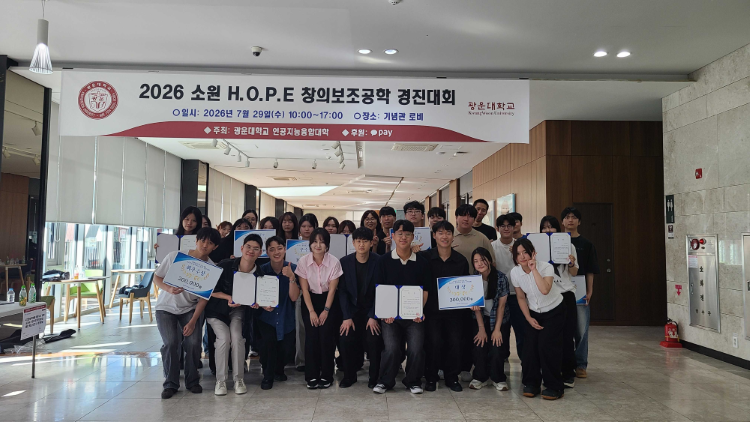
The H.O.P.E. Creative Assistive Technology Competition was successfully held on July 29, 2026, at the 80th Anniversary Memorial Hall of Kwangwoon University. Organized by Sowon, the software volunteer group affiliated with the College of Artificial Intelligence Convergence, and sponsored by Kakao Pay, the event was held under the slogan "Helping Others through Practical Engineering (H.O.P.E.)". It was designed to provide students with hands-on experience in applying technology to create meaningful social value.
Held under the theme "Creative Projects Based on Assistive Technology," the competition brought together 10 teams composed of students from Kwangwoon University and several other universities. Over the course of approximately four months, beginning in April, participants planned and developed assistive technologies and services aimed at improving the quality of life for individuals with physical challenges, including people with disabilities and older adults.
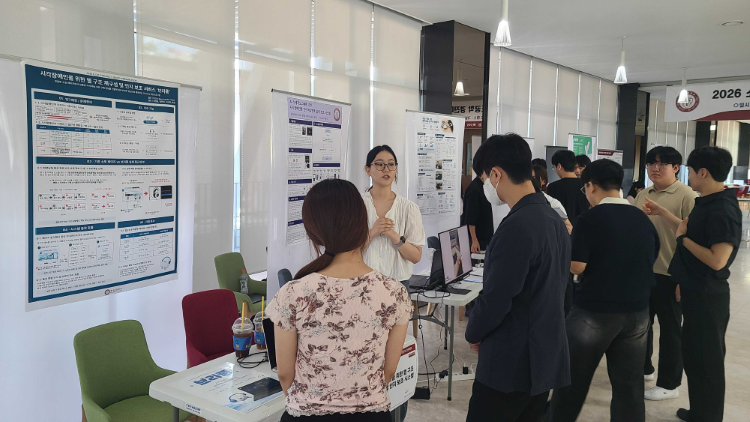
On the day of the event, each team demonstrated its project and delivered presentations at exhibition booths set up in the lobby of the 80th Anniversary Memorial Hall. At the same time, a conference was held in the seminar room, where participants introduced educational content developed from their technological innovations. Projects were evaluated by faculty members from the College of Artificial Intelligence Convergence based on creativity, practicality, and technical completeness for the project category, as well as educational applicability for the conference category.
Collaboration Beyond Departments and Universities
One of the most notable aspects of this year's competition was the diversity of the participating students. Even within Kwangwoon University, students from the School of Software, Department of Electronics Convergence Engineering, School of Information Convergence, and Department of Robotics Engineering collaborated by combining expertise from their respective disciplines. With additional participation from students at Kookmin University and Chung-Ang University, the competition evolved beyond a single-university event into a collaborative platform that brought together students from multiple institutions.
A representative example was Team "Hope Circuit," which developed a soft rehabilitation robot designed to assist upper-limb recovery for patients with neurological disorders and stroke. The project was created through collaboration between students from Kwangwoon University and Kookmin University, integrating expertise in robotics engineering and information convergence technologies. Such interdisciplinary and inter-university collaboration demonstrated the innovative outcomes that can be achieved when students with diverse academic backgrounds work toward the common goal of advancing assistive technology.
Award-Winning Projects
Among the 10 participating teams, nine teams received awards, including the Grand Prize, Excellence Awards, Outstanding Awards, and Encouragement Awards. The Grand Prize was awarded to Team "Raspberry," consisting of Taeho Oh, Hansol Ryu, Jaein Jeong, Seungheon Lee, and Eunchae Heo from the School of Information Convergence. Under the supervision of Professor Youngjae Park, the team developed an assistive system that utilizes AI-based steganography to conceal and protect the password entry process, enabling visually impaired users to operate smart devices more securely.
Two teams received the Excellence Award. Team "Hope Circuit," composed of Byeonggyu Ahn, Changbin Park, Giwoong Ryu, and Sungjae Gu from the Department of Robotics Engineering and the School of Information Convergence, represented a joint collaboration between Kwangwoon University and Kookmin University. Supervised by Professor Yesop Lee, the team developed a wire-driven soft rehabilitation robot designed to support upper-limb recovery for patients with neurological disorders and stroke. The second Excellence Award went to Team "KW-fi," consisting of Geonjun Park, Sunhwan Kim, and Sungmin Yoon from the Department of Electronics Convergence Engineering. Guided by Professor Jinyoung Kim, the team developed a campus convenience platform that analyzes Wi-Fi quality data across the university using MATLAB and recommends optimal wireless connection paths.
The Outstanding Award was also presented to two teams. Team "Reminiscence," consisting of Hyowon Lee, Dain Song, Daeun Kim, Gyuri Park, and Sieun Jeong from the School of Information Convergence, worked under the supervision of Professor Sangmin Lee to develop an AI-powered conversational smart care frame that supports emotional well-being and cognitive stimulation for people with dementia through natural daily conversations. Meanwhile, Team "ReCreator Crew," composed of Se-eun Hong, Jeongyun Lim, Yeonjin Jeong, and Seohyun Ha, also from the School of Information Convergence and supervised by Professor Youngjae Park, developed a cognitive assistance system that restructures webpage layouts to make them easier for visually impaired users to understand and navigate.
The Encouragement Award was presented to four teams. Team "EduBridge," consisting of Seohyun Bin, Yujin Kim, Yeojin Jang, and Yeonseo Yoon from the School of Information Convergence, under the supervision of Professor Gyudong Park, developed a learning assistance system that structures textbook content while integrating Braille and voice output for visually impaired students. Team "Jeongyung Goneung," composed of Jiwoo Lee, Areum Yoo, Wonjun Jang, and Juseok Lee, also supervised by Professor Gyudong Park, introduced a gamified Korean pronunciation training application that uses AI to analyze pronunciation errors and help children aged 8 to 12 with articulation and phonological disorders improve their speech through interactive gameplay. Team "Okuigwan," consisting of Yujin Jeong, Yichan Yoo, and Geukmin Kim under the guidance of Professor Yesop Lee, developed a mobility assistance system that combines a smart hat with vibration-enabled shoes to help people with hearing impairments recognize the direction of surrounding sounds. Finally, Team "SimAn Project," composed of Jinyoung Bae and Kangrok Lee from the School of Software and supervised by Professor Gyudong Park, developed a service that analyzes photoplethysmography (PPG) biosignals to classify stress levels and predict and manage panic attacks before they occur.
Bringing Technology Closer to Society
More than simply showcasing technological innovation, this competition provided students with a meaningful opportunity to empathize with real-world social challenges and develop practical solutions that enable people with disabilities, older adults, and individuals experiencing temporary physical limitations to lead more independent lives in areas such as daily living, employment, and education. Participants gained comprehensive, hands-on experience throughout the entire innovation process—from identifying social needs and conducting research to designing educational content, developing assistive devices, services, and implementation strategies, and ultimately preparing their work for future academic publication.
The creative ideas presented during the competition will be further refined through follow-up research and scholarly publications, while also serving as educational content for Sowon. Bringing together students from different universities and academic disciplines, the competition demonstrated how technology can be harnessed to improve people's lives and will be remembered as an exemplary model of practice-oriented engineering education.
This program was supported by the Kakao Pay Development Fund for IT Education to Bridge the Digital Education Gap.




