"An Invention-Track Admittee Went on to Build a Robot Company the World Is Watching”
- Sunghae Hwang (Class of ’01, Department of Computer Software Engineering), CEO of XYZ, Alumnus -
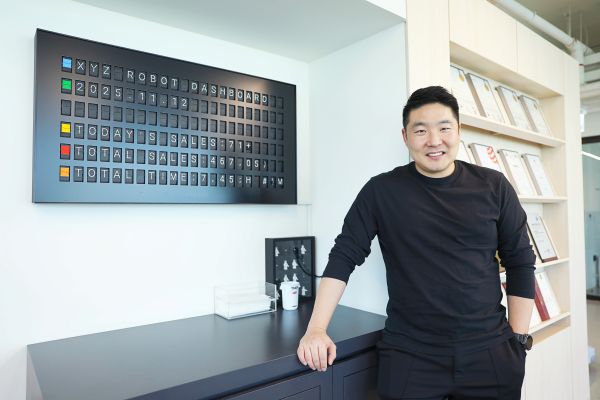
Alumnus Sungjae Hwang stands in front of a dashboard displaying, in real time,
the number of coffees made and sold by robots.
December 03, 2025. “Getting into Kwangwoon University was the start of my success in life,” says Sungjae Hwang, CEO of XYZ and a leading figure in the service-robot industry. Entering the University in 2001 through a special admissions track for student inventors, he initially struggled due to a weak foundation in mathematics.
Today, however, he is building what he calls “technology you can’t go back from.” At the robot café operated by his company, a cup of coffee is brewed every 30 seconds, drawing visitors from around the world eager to witness robot baristas in action.
Failure Is a Stopover on the Road to Success
“Hard work doesn’t automatically guarantee success,” Hwang explains, “but it’s difficult to find anyone who has succeeded without effort.” He describes success and failure as a continuous cycle, emphasizing that what matters is achieving a better failure and a better success than the day before.
For him, academic achievements, entrepreneurship, and even small daily setbacks coexist. Each experience, whether success or failure, must bring him incrementally closer to the destination he truly seeks.
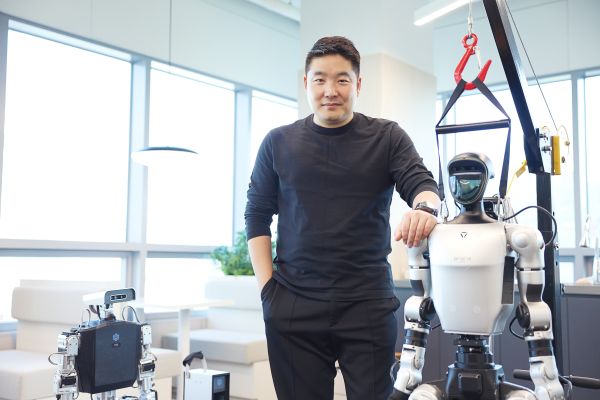
A humanoid robot currently under development at XYZ.
In the Age of AI, Attitude Is a Competitive Edge
Hwang stresses that while artificial intelligence may surpass humans in certain capabilities, attitude remains a uniquely human strength. He believes that how one approaches life and work accumulates into an irreplaceable competitive advantage—an insight he attributes in part to his education at Kwangwoon University.
He also highlights diligence as essential to engineering education, noting that engineering knowledge must be built step by step. While Kwangwoon students may not always be ranked first nationally, he emphasizes their capacity to love engineering and steadily build expertise through sincere effort.
Robots: Not a Convenience, but a Future Essential
Hwang argues that while robots may not feel necessary today, a future will arrive where life becomes inconvenient without them. He believes transformative technology begins by imagining unseen needs and creating solutions so effective that society cannot return to the past.
XYZ aims to realize this vision through service robots capable of brewing coffee, delivering packages, and assisting with household tasks. Central to this effort is the development of a “robot foundation model,” an AI that understands movement in the physical world.
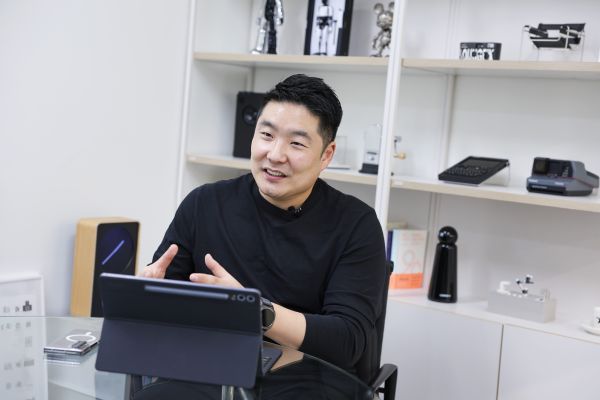
Alumnus Sungjae Hwang explains XYZ’s achievements and future growth strategy.
Experience and Balance: Preparing for the Long Game
After 15 years of relentless entrepreneurship, Hwang underscores the importance of balance. Alongside leading his company, he maintains a woodworking shop, tends a garden, runs regularly, and pursues diverse hobbies to sustain long-term growth.
He views money as a necessary tool rather than an end goal, emphasizing that true fulfillment lies in creating technology that genuinely improves everyday life. His ultimate aim is to develop products and services that, once experienced, people cannot imagine living without.
★ Watch the Interview Video with Alumnus Sungjae Hwang