“Means Over Answers”: How Kwangwoon University Built an Electronics Engineering Powerhouse
- Built on “means over answers,” KW University is an electronics engineering powerhouse in the AI era -
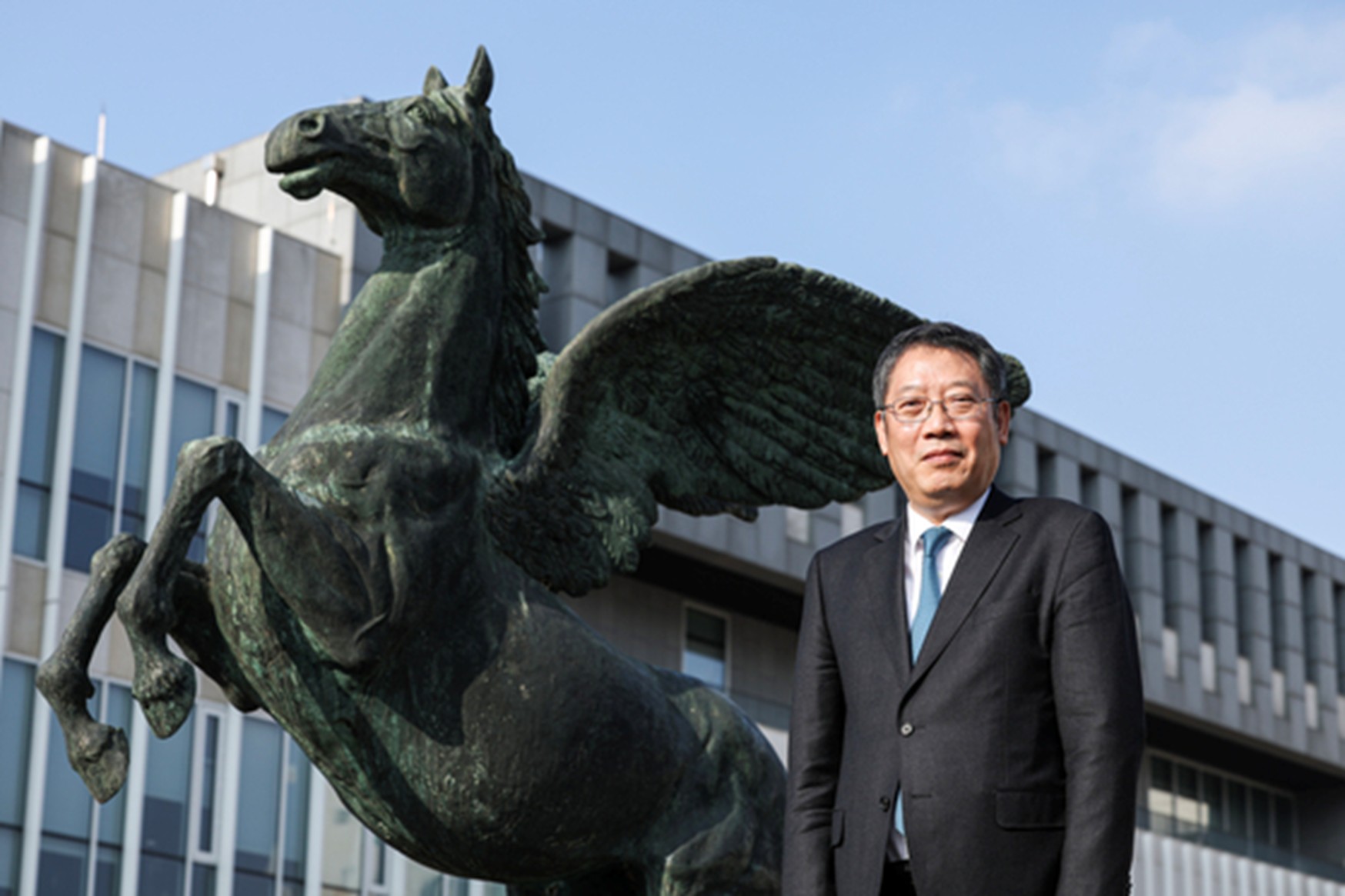 On the 17th of last
month, in front of the Winged Horse (Bima) statue at Kwangwoon
University Plaza in Nowon-gu, Seoul, President Yoon Do-young explains
the university’s strengths in electronic engineering. (Photo by Kim
Kyung-rok)
On the 17th of last
month, in front of the Winged Horse (Bima) statue at Kwangwoon
University Plaza in Nowon-gu, Seoul, President Yoon Do-young explains
the university’s strengths in electronic engineering. (Photo by Kim
Kyung-rok)
Yoon Do-young, President of Kwangwoon University
- “Innovative technology comes from diligence and perseverance”
- Produced 18 of the world’s top 2 percent scientists and 2 cabinet ministers
- “Impact over quantity” with No. 1 ranking in paper citations
- With the opening of nearby GTX and Dongbuk Line, a blueprint needed for a “wall-less university”,
growing with the local community
- Kwangwoon's “bigger role in the AI era”, as approaching its 100th anniversary in 2034
January 8th, 2026. Kwangwoon University has produced two cabinet ministers since the 2020s. Former Minister of SMEs and Startups Lee Young (2022–2023), a mathematics graduate, ran a cryptography-based startup for over 20 years before being appointed minister. Bae Kyung-hoon, Deputy Prime Minister and Minister of Science and ICT in the Lee Jae-myung administration, who oversees artificial intelligence policy, completed all of his bachelor’s, master’s, and doctoral degrees in electronic engineering at Kwangwoon University.
Kwangwoon University is a stronghold in science and engineering, having established Korea’s first electronic engineering department in 1964. Recently, employment rates in semiconductor-related departments have approached 80 percent. During a visit to the Nowon-gu campus last month, first-year electronic engineering students showcased skills they had developed over a year. A hand-shaped robot recognized human movements through a camera and picked up objects like a human hand. Students said they were able to implement technologies that are difficult to learn from books or the internet through countless trials and errors.
Meeting in his office, President Yoon, 62, said the greatest strength of Kwangwoon students is sincerity. He explained that the experience of staying late in brightly lit laboratories and persistently solving problems becomes a driving force that is recognized later in society. The following is a question-and-answer session with President Yoon.
Q: You were appointed president despite being from a non-electronics field at a university dominated by electronic engineering. Your major is chemical engineering.
Yoon: When researching chemical engineering, there are cases where help from electronic engineering is necessary. The university supported me with expensive electronic engineering equipment needed to study microscopic material flows. Thanks to this support, in 2011 we signed a Cooperative Research and Development Agreement with the U.S. Air Force. This was the first such agreement made with an institution outside the U.S. military.
When I was dean of the Graduate School of Environment, I recognized demand from people who wanted to sincerely study environmental issues rather than simply earn degrees. I personally oversaw student recruitment, academic operations, and lectures. Environmental activists, business leaders, and politicians all attended the courses. I believe these results earned support from those around me.
Q: The campus is located at the foot of Bukhansan, so the air feels clean.
Yoon: We are surrounded by Seoul’s famous mountains, including Bukhansan and Dobongsan, with Suraksan and Bulamsan nearby. The Ui Stream and Jungnang Stream flow between them, making this a very favorable location.
Our founder, Dr. Cho Kwang-woon (1899–1980), established the school in 1934 under the name Joseon Wireless Training Institute to teach communications technology. It was originally located in Bongnae-dong near Namdaemun and later settled here after liberation. There are historical records showing that Kwangwoon graduates trained in communications played important roles during the Korean War. Graduates from the electronic engineering department established in 1964 became leaders in the development of radios, mobile phones, and semiconductors.
Q: How does Kwangwoon University view artificial intelligence?
Yoon: Predictions such as “ChatGPT will do everything” or “software developers will disappear in the AI era” are incorrect. Coding must be practiced directly. To input detailed variables and control situations appropriately, hands-on experience is essential.
If you are developing a material that coats semiconductor surfaces, you must experiment step by step to determine appropriate vacuum levels and understand how they affect dust-proofing and waterproofing. Developing advanced electronic components like semiconductors is not a simple process.
Q: AI-assisted academic misconduct has become controversial.
Yoon: University education must evolve with the times. Instead of asking for correct answers, it is more appropriate to ask how students approached a problem.
We should not be confined to thinking in terms of electronic devices that only switch between off and on. Artistic sensitivity rooted in analog thinking is necessary to build the ability to control AI. Our founder once said that no matter how advanced science and technology become, they must be imbued with human dignity.
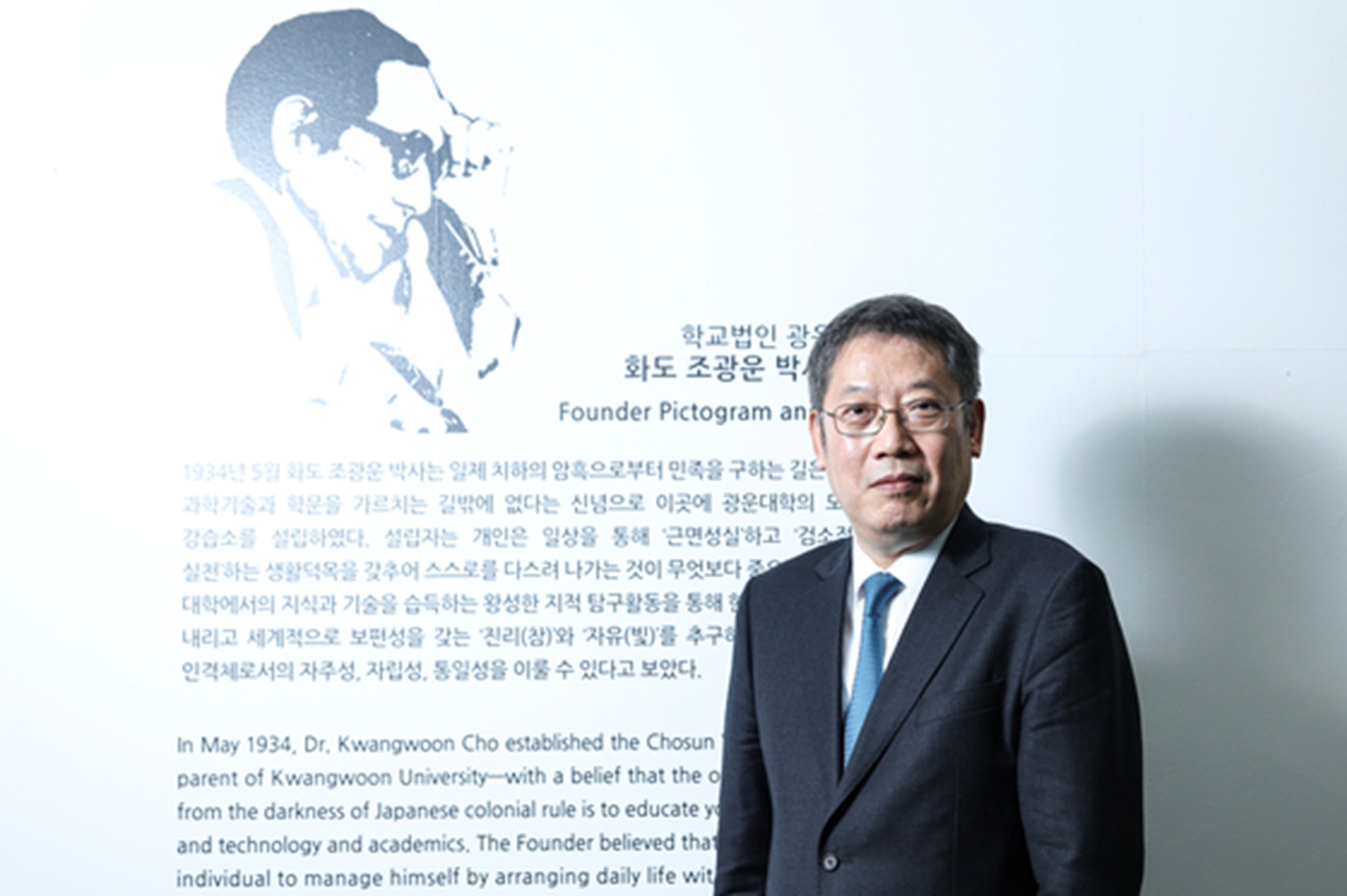
In front of a plaque introducing founder Cho Kwang-woon at the main entrance of Kwangwoon University’s Central Library in Nowon-gu, Seoul, President Yoon explains the school’s founding history.
(Photo by Kim Kyung-rok)
Q: Kwangwoon ranked first in paper citations in the 2025 JoongAng Ilbo university evaluation.
Yoon: We do not simply ask professors to increase the number of papers. Instead, we prioritize research impact. We operate a citation incentive system that awards 50,000 won per citation, up to a maximum of 10 million won per year. Papers published in internationally renowned journals such as Nature, Cell, and Science receive an incentive of 30 million won.
Q: The university has produced 18 scientists ranked among the world’s top 2 percent.
Yoon: Eighteen professors were selected as top 2 percent scientists by Stanford University and global academic publisher Elsevier. Recently, young professors in the semiconductor field have shown particularly strong performance.
Professor Chae Joo-hyung of electronic communications engineering developed the world’s first low-power semiconductor technology. He previously worked as a high-level memory design expert at a major semiconductor company. Professor Koo Sang-mo of electronic materials engineering was appointed last month as head of the Ministry of Trade, Industry and Energy’s task force for next-generation power semiconductors. He leads government efforts to develop core components for data centers and electric vehicles.
Q: The GTX-C line will pass through Kwangwoon University Station.
Yoon: It will connect to Samseong Station in Gangnam in just nine minutes. From Suwon, where many semiconductor companies are located, the trip will take 33 minutes. In 2027, the Dongbuk Line, a Seoul light rail connecting Wangsimni Station and Sanggye Station, will also pass through Kwangwoon University Station. Nearby Jangwi-dong in Seongbuk-gu is undergoing redevelopment. We are planning a new campus vision based on the concept of a wall-less university that grows together with the local community.
Q: The university will mark its 100th anniversary in 2034.
Yoon: Since its founding in 1934, we believe we have continuously contributed to the electronics industry and national development for more than 90 years. Moving beyond the information age into the AI era, we aim to play an even greater role in society.
Profile: President Yoon Do-young : Yoon graduated from Seoul National University’s Department of Chemical Engineering in 1986 and earned his master’s and doctoral degrees there. After completing postdoctoral research at the University of Florida, he joined Kwangwoon University in 1993. He has served as Vice President for Academic Affairs, Dean of the College of Engineering, and Dean of the Graduate School of Environment. He became the 13th president of Kwangwoon University in July 2025. He received commendations from the Deputy Prime Minister of Education and the Mayor of Seoul in 2006 for contributions to national industrial development. His awards include the U.S. Air Force Best Paper Award in 2011 and the Korean Institute of Chemical Engineers Academic Award in 2016.


