Global Coexistence HUSS Project Group Successfully Hosts the 2026 Problem-Solving Policy Competition for Sustainable Local Communities
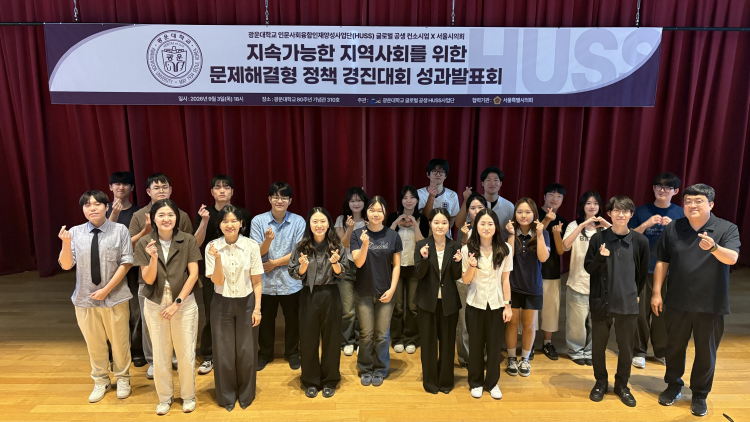
Group Photo from the 2026 Problem-Solving Policy Competition for Sustainable Local Communities
Kwangwoon University's Humanities and Social Sciences Convergence Talent Development (HUSS) Project Group held the final presentation session of the 2026 Problem-Solving Policy Competition for Sustainable Local Communities on September 3, 2026, in Room 310 of the university's 80th Anniversary Memorial Hall.
The policy competition was organized to encourage students to identify challenges facing local communities and independently develop policy solutions. Beginning with a preparatory workshop and expert mentoring sessions in May, participating students spent approximately three months developing and refining their policy proposals.
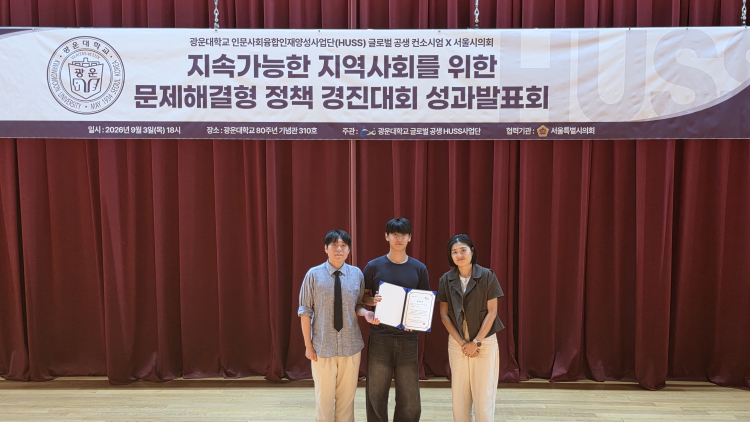
At the final presentation session, a total of five teams presented their policy proposals. Following the evaluation, Team Donggo Dongrak received the Grand Prize. Team Polis and Team Ieogage were awarded Excellence Prizes, while Team Sobanggwan and Team Jeongchaek Matjip received Encouragement Prizes.
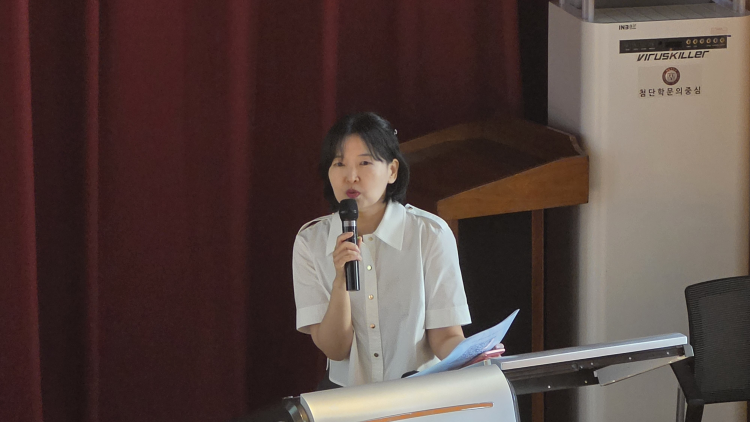
Lee Hye-young, Director of Kwangwoon University's HUSS Project Group, Delivers the Opening Remarks.
Team Donggo Dongrak, consisting of team leader Han Woo-jin and team member Heo Yeon-jin, proposed a “Demand-Based Hospital Transportation Support System” aimed at improving healthcare accessibility for elderly residents in rural areas. The proposed system integrates vehicle allocation and accompanying personnel services based on medical appointment schedules, helping reduce the difficulties elderly residents face when traveling to hospitals. By linking existing transportation assistance services with scheduled medical appointments, the policy seeks to ensure that elderly residents can receive both transportation and accompaniment support when they need it.
Team Polis, consisting of team leader Lee Chae-rin and team member Kim Jeong-hwa, proposed “Battery ON,” an initiative designed to increase the collection rate of used portable power banks. The proposal includes installing smart collection bins in residential neighborhoods, introducing a QR code-based participation reward system, and using Internet of Things (IoT) technology to monitor and manage the capacity of collection bins. The initiative focuses on encouraging residents to participate in the proper disposal of used portable power banks while improving the efficiency of the collection process.
The judging panel consisted of Dr. Ko Hyo-jin of the Seoul Metropolitan Council and Professors Kim Kyung-dong and Jang Min-ju of Kwangwoon University. The judges evaluated each team's policy proposal based on five criteria: clarity of problem identification, creativity of the proposed policy, feasibility of implementation, social impact, and logical coherence and overall completeness.
Through this policy competition, participating students gained valuable experience in applying their academic knowledge to real-world challenges facing local communities and transforming policy ideas into concrete proposals. In particular, feedback from experts enabled students to critically examine their target beneficiaries, implementation strategies, and practical feasibility, deepening their understanding of policy design and its real-world applications.
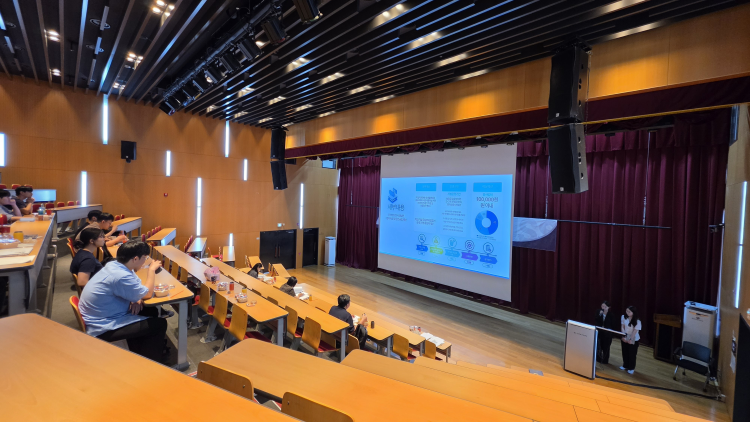
(Top) A total of five teams presented their problem-solving policy proposals for sustainable local communities.
(Bottom) Team Donggo Dongrak, winner of the Grand Prize for its proposal, “Demand-Based Hospital Transportation Support System,” with Dr. Ko Hyo-jin.
Meanwhile, the Global Coexistence HUSS Consortium has been operating from 2024 to 2026 with financial support from the Ministry of Education and the National Research Foundation of Korea (NRF), with the aim of fostering interdisciplinary talent in the humanities and social sciences.




